By Dr. Katchia Gethers, Charleston Education Partners (CEP)
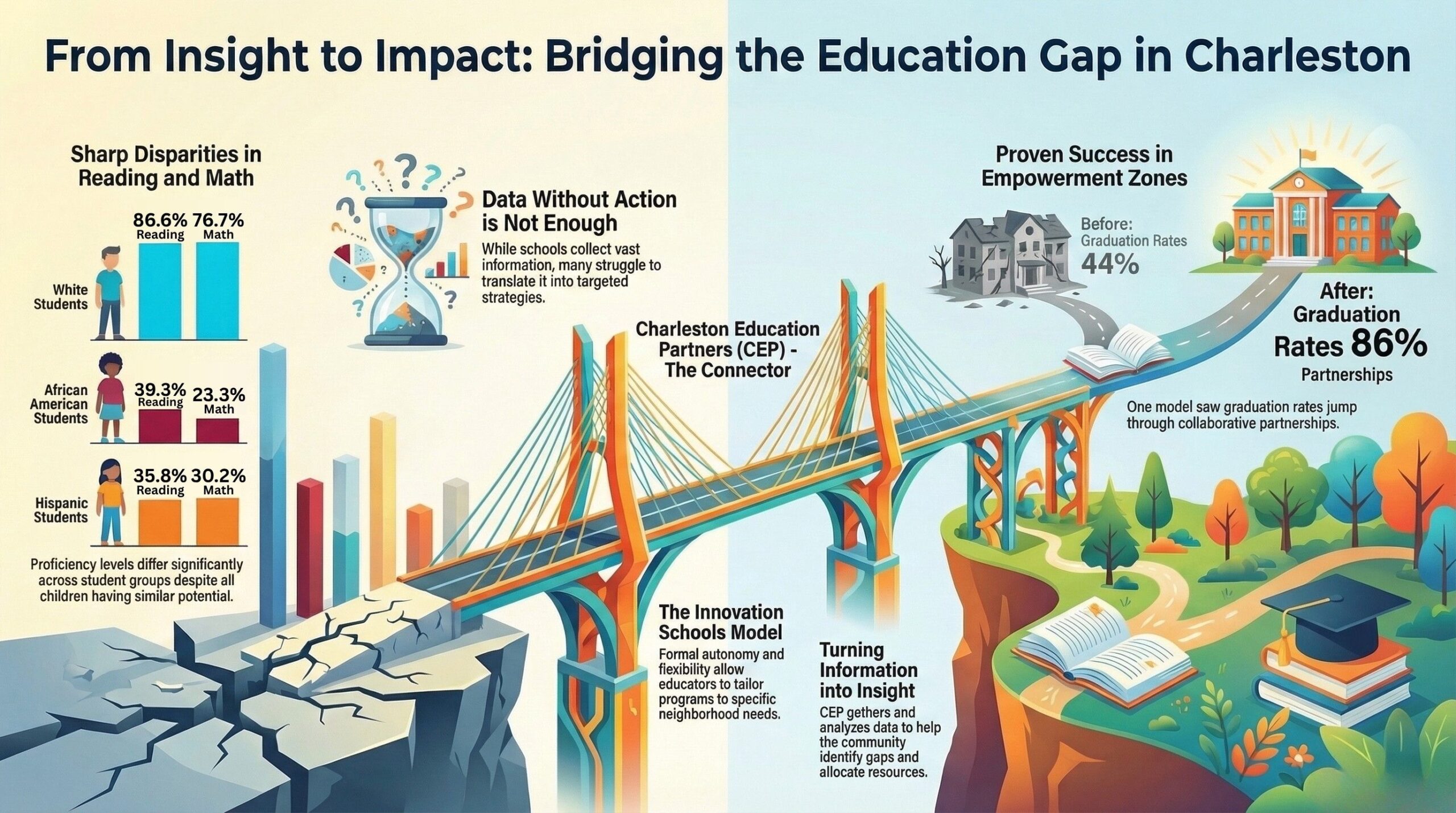
In education, data is everywhere. Test scores, attendance rates, graduation statistics, workforce projections, and community demographics all offer valuable insights. But data alone does not improve schools or expand opportunity for students.
What matters is what we do with it.
Across the country, communities are recognizing that data must be translated into action, action that is collaborative, intentional, and focused on student success. That is where organizations like Charleston Education Partners (CEP) play a critical role.
Turning Information into Insight
Research consistently shows that while schools collect large amounts of information, educators and communities often struggle to translate that data into clear decisions and targeted strategies. National education policy leaders emphasize that effective data systems should help communities identify gaps, guide resource allocation, and support continuous improvement across schools.
CEP works to close that gap in Charleston by gathering, analyzing, and translating education data into information the community can use to strengthen schools and expand opportunity.
Learning from Communities Doing Similar Work
Charleston is not alone in facing the challenges of a diverse school district serving urban, suburban, and rural communities. Across the country, districts similar to Charleston County School District have used data partnerships to improve outcomes.
Nashville, Tennessee
In Metro Nashville Public Schools, city agencies and education partners created data-sharing agreements that allowed afterschool programs to tailor support to individual students. By sharing academic and program participation data, community partners were able to design targeted interventions that strengthened reading outcomes and student engagement.
Today, Nashville's partnership model includes more than 20 community organizations providing resources and services to families, demonstrating how coordinated data and partnerships can expand support for students beyond the classroom.
Seattle Region – Road Map Project
In the Seattle area, the Road Map Project brings together school districts, community organizations, and local governments to track shared education indicators and align community action. The partnership uses publicly available dashboards and shared metrics to measure progress toward improving student outcomes and closing opportunity gaps.
The model has become a national example of how community data systems can guide cross-sector collaboration to improve education outcomes.
Chicago, Illinois
In Chicago, the nonprofit Communities In Schools partners with more than 175 schools and over 200 service providers to connect students with resources ranging from health services to academic support. By coordinating services and tracking student needs, the organization helps remove barriers that prevent students from succeeding in school.
This approach reflects a growing national understanding that improving education outcomes requires coordination between schools and community partners.
Why This Matters for Charleston
Like many of these communities, Charleston County School District serves a diverse student population across a large geographic region. The challenges are complex ranging from opportunity gaps to workforce alignment and access to resources.
CEP helps the community navigate these challenges by providing:
- Clear, accessible education data
- Research and analysis on student outcomes
- Community engagement around education priorities
- Partnerships that connect schools, businesses, and community leaders
By doing so, CEP helps Charleston move beyond simply discussing challenges to identify solutions grounded in evidence and collaboration.
From Insight to Action
The goal of data is not simply to measure progress; it is to improve it.
When communities align around shared information:
- Schools can target resources where they are needed most
- Community partners can design programs that address real gaps
- Employers can connect workforce opportunities to education pathways
- Families gain clearer insight into opportunities for their children
Across the country, communities that use data-driven collaboration are seeing stronger alignment between schools, community organizations, and workforce needs.
Charleston can build on those lessons.
A Community Effort
Improving education outcomes is not the responsibility of schools alone. It requires the collective effort of educators, families, community organizations, business leaders, and policymakers.
Charleston Education Partners serves as a connector within that ecosystem, helping the community understand the data, align around shared goals, and take meaningful action on behalf of students.
Because when information becomes insight, and insight leads to action, students benefit, communities grow stronger, and the future becomes brighter for everyone.